 Pufferfi
 validator tickets let operators prepay validator days and can increase pufETH backing
Pufferfi validator tickets (VTs) are ERC20 tokens that give an operator the right to run a staker-funded Ethereum validator for one day per ticket. Minting tickets with ETH can add rewards to the backing of pufETH, Puffer Finance's native liquid restaking token. Operators lock tickets alongside a bond and retain the validator's proof of stake (PoS) rewards during their covered operating period. The prepaid ticket cost is known before operation, while actual earnings and expenses determine the operator's margin.
Bottom line: Ticket expenditure prepays operating days, while an active validator's pufETH bond refund depends on its exit balance and slashing status.
Who earns the rewards that a Validator ticket prepays?
pufETH holders receive the vault's allocated share of ticket payments through the token's ETH backing, while a registered node operator earns the validator's actual PoS rewards during the operating days that locked tickets cover. The allocation depends on fees and the Burst Threshold. The operator then takes responsibility for earning enough from validation to cover that expenditure.
A pufETH holder keeps the same token balance as rewards accrue because the token does not rebase. Increased backing changes the ETH value represented by each token. Validator performance affects the operator's earnings after the upfront payment; it does not reverse that payment to the pool. Penalties that exceed the available protection can still reduce pufETH backing.
Holding VTs gives no automatic claim on validator earnings before an operator registers and activates a funded validator.
ETH backing and prepaid reward accounting
The vault's share of ETH ticket payments adds rewards to pufETH backing. Ticket issuance connects an operator's prepaid expenditure with the staker's redemption value. The accounting relationship is the pool's backing divided by its pufETH supply. Rewards increase the numerator, while losses reduce it. Deposits that mint proportionate pufETH shares increase backing and supply together. ETH ticket payments increase backing without minting pufETH for the payer only to the extent that funds reach the vault. The documented implementation deducts protocol and Guardian fees; pufETH purchases burn the remainder instead, reducing supply. If the oracle flags the Burst Threshold, Puffer's validator-share cap, either payment goes entirely to the treasury without adding backing or burning pufETH.
Validator funding moves ETH from the vault into staking without removing that ETH from the backing calculation.
The pool includes provisioned validator ETH in its accounting through the oracle's reported locked amount. A higher accounting claim does not make all backing immediately available for pufETH withdrawals. ETH committed to validators remains part of the claim while awaiting the relevant exit and liquidity processes.
Activation starts the ticket period
A validator's paid ticket period begins when it activates on the Beacon Chain. Registration checks and ETH provisioning precede activation, so registration does not start the operating clock. Each ticket represents one validator-day. Time spent awaiting provisioning or activation is distinct from active validation time.
The registration guide specifies at least 28 VTs per validator and a pufETH bond worth 2 ETH. The technical protocol description distinguishes a 1 ETH bond for validators using a verified anti-slasher enclave from 2 ETH without one. The protocol supplies the validator's 32 ETH stake from pooled funds after accepting the registration. Provisioning requires enough vault liquidity and capacity in the selected module. The 28-ticket figure describes that registration configuration; a different configured minimum changes the initial commitment.
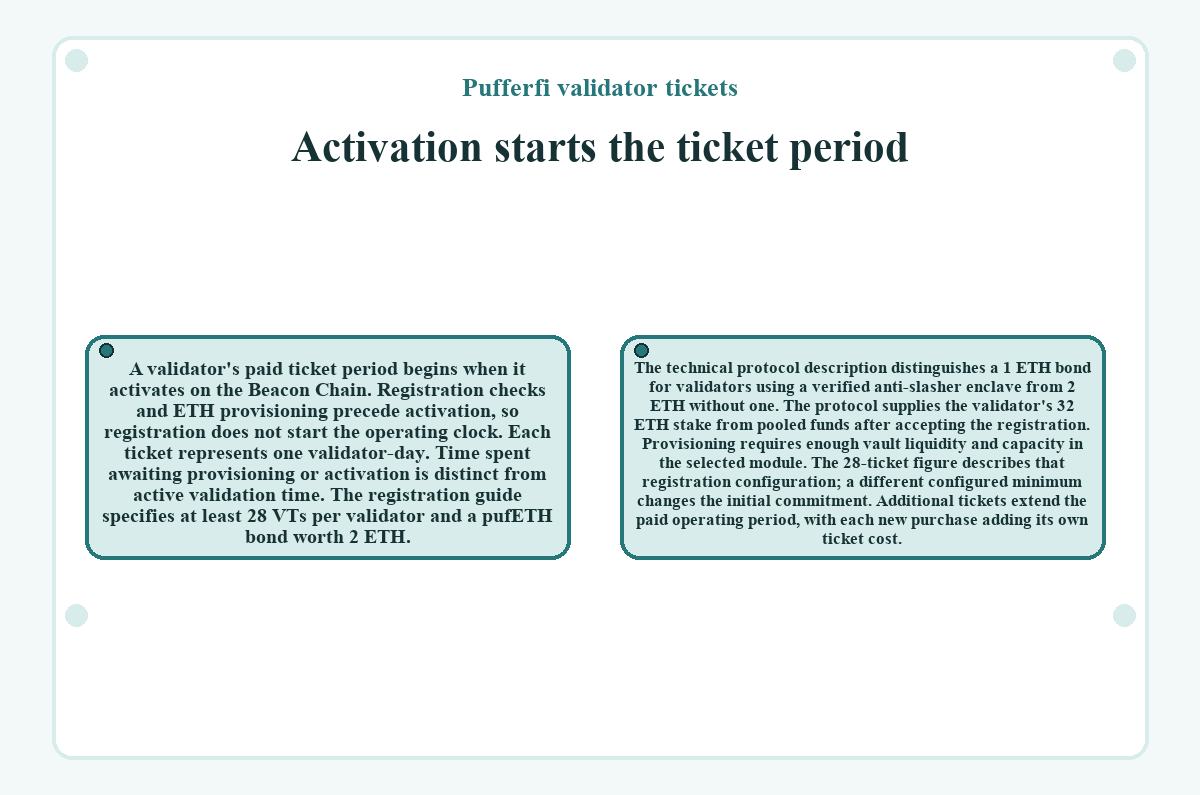
Additional tickets extend the paid operating period, with each new purchase adding its own ticket cost.
Ticket prices and operator margins
The VT pricing model uses expected daily consensus and execution rewards to calculate a prepaid price, with a discount intended to leave an earnings margin for the operator. Its relationship is
ticket price = expected daily validator rewards × (1 - discount)
. The expectation supplies a pricing input; the validator's eventual earnings supply the actual income.
Consensus rewards and execution rewards contribute differently to that expectation. Validator performance affects income, while changes in the validator population and MEV conditions affect the revenue that the pricing model estimates. MEV means maximal extractable value. A ticket price can therefore change as the earnings inputs change.
A discount from expected revenue does not fix realized profit. Comparing actual validator earnings with the ticket expenditure shows the gross operating margin. Registration gas and other operating costs also affect what remains. The refundable bond adds a separate capital requirement even when no penalty ultimately consumes it.
Bonds, registration checks and ticket penalties
The pufETH bond covers validator losses under the bond rules, while Validator Tickets pay for the right to operate during the covered period. An unslashed validator exit that returns at least 32 ETH qualifies for a full bond refund in the described setup. If an unslashed validator returns less, the shortfall comes from the bond. A slashed validator causes the operator to forfeit the entire bond. Losses beyond the available collateral can reach the pool. The bond therefore provides a finite buffer alongside the prepaid reward mechanism.
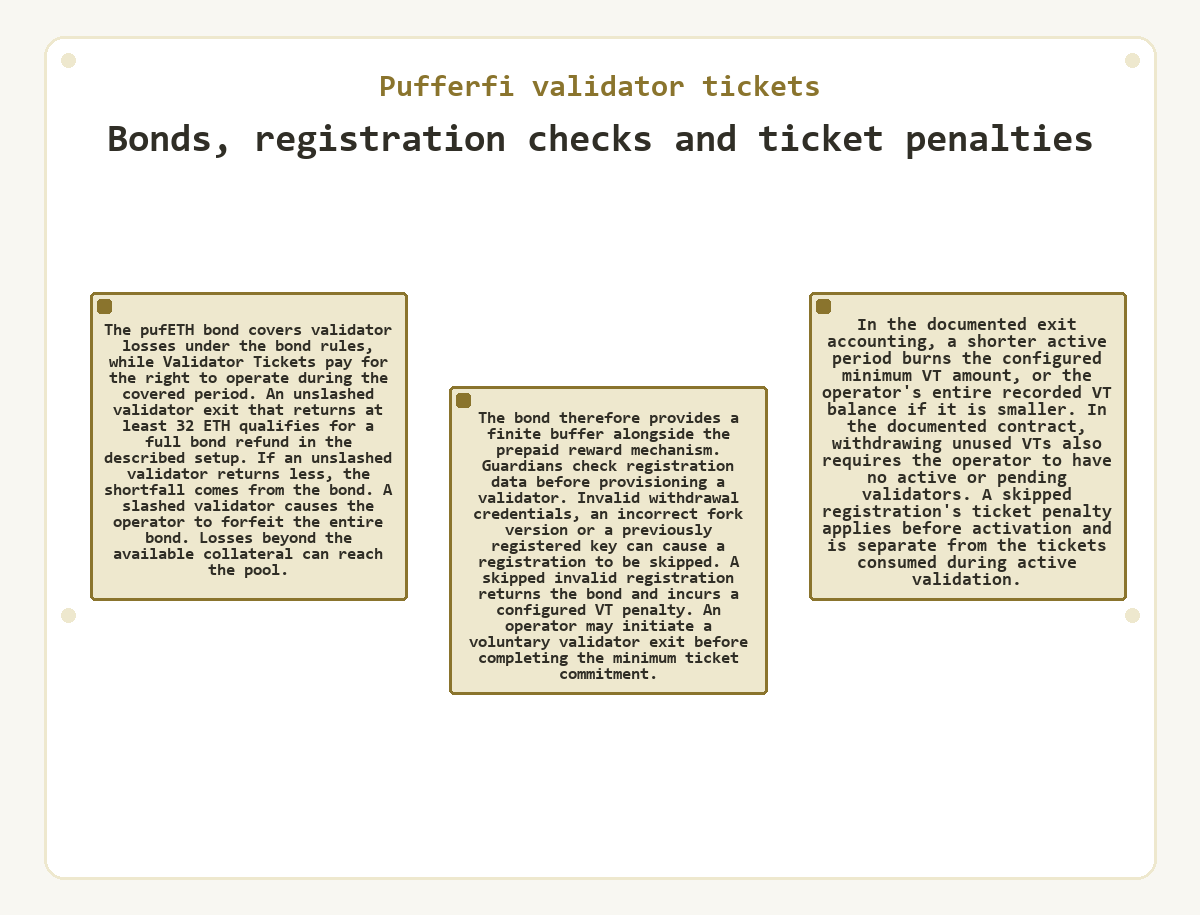
Guardians check registration data before provisioning a validator. Invalid withdrawal credentials, an incorrect fork version or a previously registered key can cause a registration to be skipped. A skipped invalid registration returns the bond and incurs a configured VT penalty. An operator may initiate a voluntary validator exit before completing the minimum ticket commitment. In the documented exit accounting, a shorter active period burns the configured minimum VT amount, or the operator's entire recorded VT balance if it is smaller. In the documented contract, withdrawing unused VTs also requires the operator to have no active or pending validators.
A skipped registration's ticket penalty applies before activation and is separate from the tickets consumed during active validation.
Ticket balances and continued operation
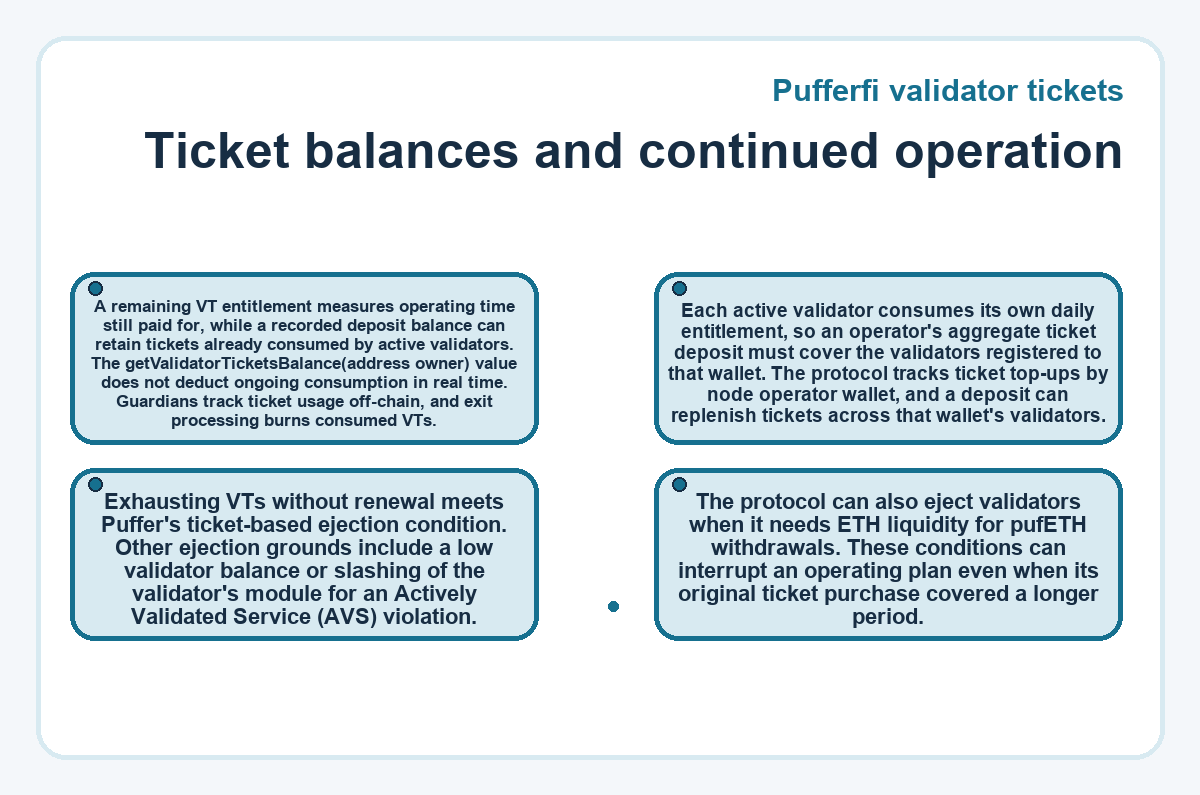
A remaining VT entitlement measures operating time still paid for, while a recorded deposit balance can retain tickets already consumed by active validators. The
getValidatorTicketsBalance(address owner)
value does not deduct ongoing consumption in real time. Guardians track ticket usage off-chain, and exit processing burns consumed VTs. Each active validator consumes its own daily entitlement, so an operator's aggregate ticket deposit must cover the validators registered to that wallet.
The protocol tracks ticket top-ups by node operator wallet, and a deposit can replenish tickets across that wallet's validators. Exhausting VTs without renewal meets Puffer's ticket-based ejection condition. Other ejection grounds include a low validator balance or slashing of the validator's module for an Actively Validated Service (AVS) violation. The protocol can also eject validators when it needs ETH liquidity for pufETH withdrawals. These conditions can interrupt an operating plan even when its original ticket purchase covered a longer period.
Ticket commitments before registration or extension
Prepaying VTs makes the ticket expenditure known for the purchased validator-days, while the operator's eventual margin still depends on earnings and penalties during the covered period.
- Use the ticket price actually paid when judging the prepaid cost; expected validator revenue is a separate quantity.
- Apply the registration minimum for the selected configuration and start counting covered days from Beacon Chain activation.
- Reserve the pufETH bond separately from ticket expenditure because its refund depends on the validator's exit outcome.
- Account for consumed tickets across active validators before treating a recorded deposit balance as remaining entitlement.
- Include any early-exit VT penalty when assessing departure before the minimum operating commitment.
The economics of extending operation change if new tickets cost more or expected validator revenue falls. A profitable initial commitment does not establish that the next purchased period will also be profitable.
Pufferfi validator tickets FAQ
Do Puffer Validator Tickets have to be minted in a separate transaction?
The registerValidatorKey interface supports funding paths that can mint tickets within the registration call. It can mint pufETH and VTs from direct ETH funding. Existing tokens can enter through Permit messages or prior approvals, and the interface can combine those methods. The selected registration interface determines the available funding paths.
Are unlocked Puffer Validator Tickets tradable?
Unlocked Validator Tickets are ERC20 tokens that can be transferred and obtained through secondary trading. Their transferability does not establish an available buyer or a particular market price. A transferee acquires the tickets, while operating a funded validator still requires the bond and valid registration. Tokens held freely differ from VTs already committed within the protocol.
Can a Safe multisig supply Validator Tickets for registration?
Safe multisig wallets have a validator-registration route that supplies Validator Tickets alongside the pufETH bond. The batch workflow uses registration calldata submitted through Safe's Transaction Builder. The wallet must hold enough tickets and pufETH for its registrations. Multisig authorization changes how the contract calls are approved; it preserves the validator's funding and registration requirements.
What changes when a ticket-funded Puffer validator joins a restaking module?
Participation in a restaking module adds exposure to AVS rewards and additional collateral risks alongside the ticket-funded PoS arrangement. AVS means Actively Validated Service. A node operator can receive a portion of the module's restaking rewards, while governance selects the permitted services and restaking operator. One VT represents expected PoS rewards for a validator-day, not every possible reward from those services.
Where does a ticket-funded Puffer validator send execution rewards?
Execution rewards go to the fee recipient address configured in the operator's beacon node client. The operator sets fee_recipient to their own wallet, consistent with retaining execution rewards under the VT model. Consensus rewards follow separate EigenLayer accounting. Changing the execution fee recipient therefore does not direct both reward streams to that wallet.