 Pufferfi
 withdrawals convert pufETH to WETH through liquidity-backed exits or two-step claims
Pufferfi withdrawals convert pufETH, Puffer's liquid restaking token, to WETH (wrapped ETH) through an immediate liquidity-backed exit or a request followed by a later claim. The one-step mode's documented protocol fee is 1%, and it pays WETH in one transaction when liquidity is available. The two-step mode has no protocol withdrawal fee, requires at least 0.01 pufETH and may take around 14 days. Existing vault liquidity can shorten that wait. Signing a Permit, submitting a request and receiving WETH represent different points in the standard withdrawal process. Validator bond returns and operator reward claims use separate arrangements, so the balance being withdrawn determines the applicable route.
Vault liquidity before redemption
Vault liquidity determines whether an immediate pufETH redemption can pay WETH and whether a standard request needs funds from validator exits. The ETH backing pufETH includes assets committed to validators, so token backing and available withdrawal liquidity are different quantities. A funded validator does not provide its principal as an immediately spendable vault balance. Standard requests enter batches, and a batch must contain its required number of requests before finalization, even if liquidity is sufficient. If liquidity is insufficient, the protocol exits validators to replenish it.
What does a one-step pufETH withdrawal cost?
The withdrawal guide specifies a 1% protocol fee on the withdrawn amount for the one-step mode. Ethereum transaction gas adds a separate network cost. The protocol charge reduces the payout, while gas pays for executing the transaction. In PufferVaultV5, governance can change the fee settings, and getTotalExitFeeBasisPoints() reports their combined rate.
The payout transaction
The instant mode converts pufETH into WETH and transfers the payout directly to the withdrawing wallet in a single transaction. Immediate delivery relies on the liquidity vault. Its availability concerns spendable liquidity, while the pufETH exchange rate concerns how much underlying value the submitted tokens represent.
The charge and the amount received
The submitted quantity of pufETH and the resulting WETH amount have different units. The token count alone therefore cannot describe the fee's WETH value. The amount transferred after the protocol charge is the wallet's withdrawal proceeds.
Two-step requests and the later WETH claim
A two-step withdrawal requires a minimum request of 0.01 pufETH. The standard mode has no protocol withdrawal fee and separates the request from the later payout. PufferWithdrawalManager also enforces a configurable maximum per request, returned by getMaxWithdrawalAmount(); larger requests are rejected.
Permit and request submission
A pufETH Permit authorizes the protocol to spend the tokens for the withdrawal request. Creating the request then requires a transaction that transfers those tokens to the protocol. The signature alone leaves that transfer unfinished. The standard interface records the submitted request under Withdrawal Claims in the portfolio. That entry identifies a pending withdrawal; it does not establish that WETH has reached the wallet.
Processing the withdrawal batch
The protocol groups requests into withdrawal batches and processes those batches periodically. If the vault cannot fund a batch, validator exits release principal back toward the withdrawal flow. The exit involves the Beacon Chain and EigenLayer processing. Both introduce delays before funds become available for the claim.
Claiming the processed request
A processed batch makes the standard withdrawal claimable. Batch finalization burns the committed pufETH and transfers vault ETH to the manager. The later claim wraps ETH into WETH and pays the recorded recipient. Withdrawal Claims is the interface location for completing that payout.
How soon can a two-step withdrawal become claimable?
A two-step withdrawal may become claimable well before 14 days when its batch is full, the vault has enough liquidity and no validators need to exit. The longer estimate covers liquidity shortages that require validator exits and EigenLayer withdrawal processing. The final claim transaction remains necessary after the batch becomes payable.
Puffer provisions these validators with 32 ETH each. That allocation explains why a large withdrawal batch can require several exits; it does not set the minimum pufETH request. The exit path includes a voluntary exit on the Beacon Chain and a queued EigenLayer withdrawal before funds return. An individual request therefore depends on its batch's processing and available liquidity.
Withdrawal parameters and payment constraints
The minimum concerns the two-step mode. Available liquidity is a live vault condition, so it cannot be inferred from a duration estimate or the number of pufETH tokens held.
| Parameter | Value | Payment conditions and outcomes |
|---|---|---|
| Withdrawal payout asset | WETH | The withdrawal converts pufETH into the payout token. |
| One-step protocol fee | 1% of the withdrawn amount in the withdrawal guide | Immediate payment requires vault liquidity. |
| One-step transaction count | One transaction | Conversion and transfer complete in that transaction. |
| Two-step protocol fee | No protocol withdrawal fee | Request and claim transactions still incur network gas. |
| Two-step minimum request | 0.01 pufETH | A smaller request does not meet this minimum. |
| Two-step processing estimate | Around 14 days; potentially shorter with sufficient liquidity | Validator exits and EigenLayer processing can delay readiness. |
| Validator principal allocation | 32 ETH per provisioned validator | Returning funds requires exit and withdrawal processing. |
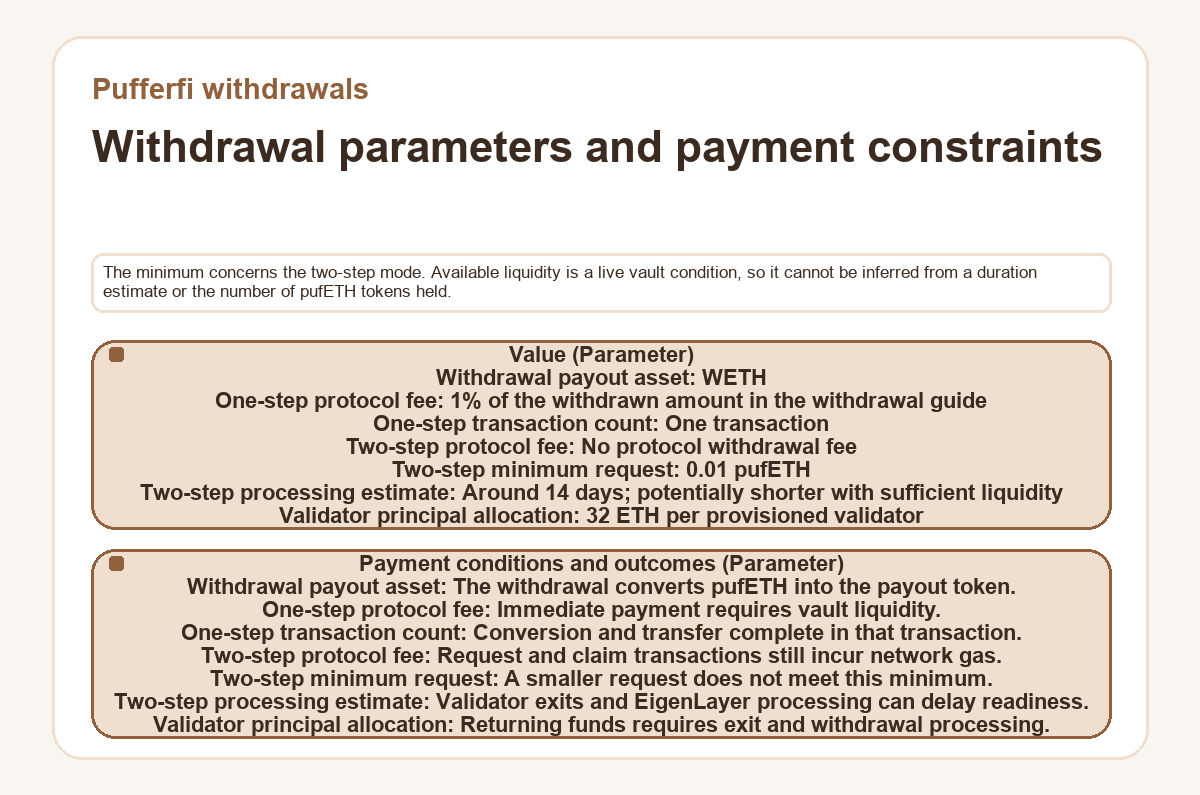
Withdrawal parameters and payment constraints
- Value (Parameter) Withdrawal payout asset: WETH One-step protocol fee: 1% of the withdrawn amount in the withdrawal guide One-step transaction count: One transaction Two-step protocol fee: No protocol withdrawal fee Two-step minimum request: 0.01 pufETH Two-step processing estimate: Around 14 days; potentially shorter with sufficient liquidity Validator principal allocation: 32 ETH per provisioned validator
- Payment conditions and outcomes (Parameter) Withdrawal payout asset: The withdrawal converts pufETH into the payout token. One-step protocol fee: Immediate payment requires vault liquidity. One-step transaction count: Conversion and transfer complete in that transaction. Two-step protocol fee: Request and claim transactions still incur network gas. Two-step minimum request: A smaller request does not meet this minimum. Two-step processing estimate: Validator exits and EigenLayer processing can delay readiness. Validator principal allocation: Returning funds requires exit and withdrawal processing.
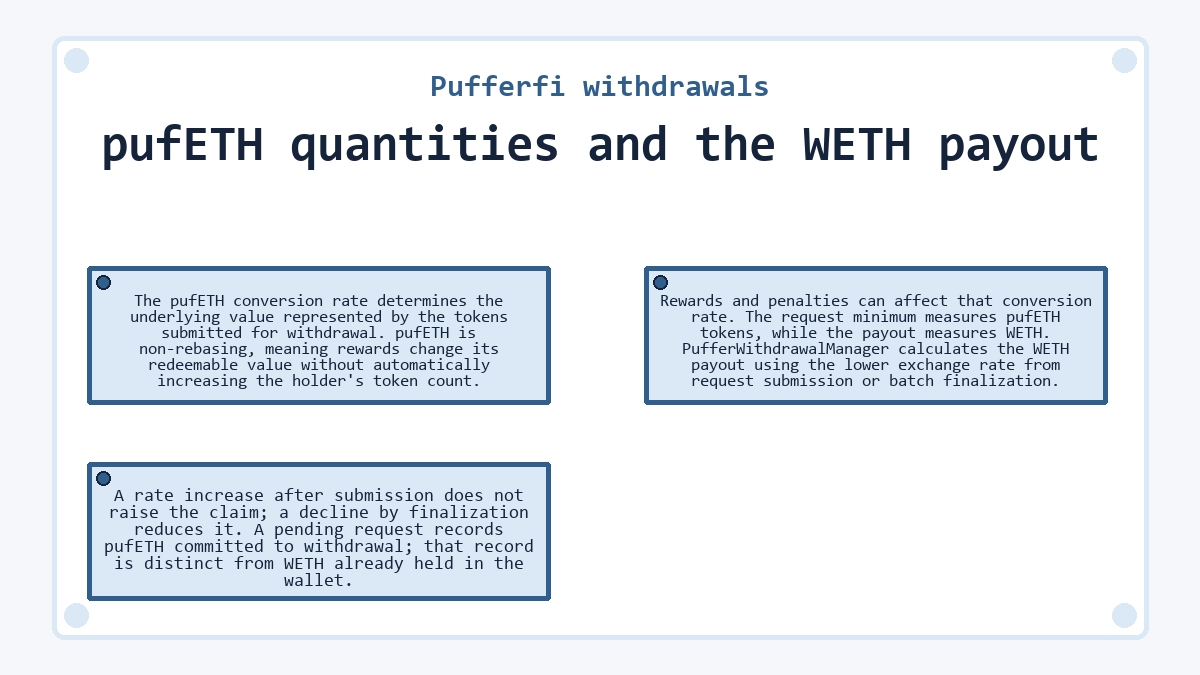
pufETH quantities and the WETH payout
The pufETH conversion rate determines the underlying value represented by the tokens submitted for withdrawal. pufETH is non-rebasing, meaning rewards change its redeemable value without automatically increasing the holder's token count. Rewards and penalties can affect that conversion rate. The request minimum measures pufETH tokens, while the payout measures WETH. PufferWithdrawalManager calculates the WETH payout using the lower exchange rate from request submission or batch finalization. A rate increase after submission does not raise the claim; a decline by finalization reduces it.
A pending request records pufETH committed to withdrawal; that record is distinct from WETH already held in the wallet.
Validator bonds and operator reward withdrawals
Operator balances follow validator-exit and reward-accounting rules that differ from a holder's pufETH redemption, including separate conditions for bond returns and consensus reward claims.
Bond returns after a validator exit
Bond recovery requires completed Beacon Chain and EigenLayer exits. The full pufETH bond returns to the operator if the validator was not slashed and exit accounting returns at least 32 ETH. An unslashed withdrawal below 32 ETH reduces the bond by the shortfall; no bond remains to return if the shortfall exhausts it. A slashed validator forfeits the entire bond. The collateral settles through validator-exit accounting, separately from a holder choosing immediate or two-step pufETH redemption.
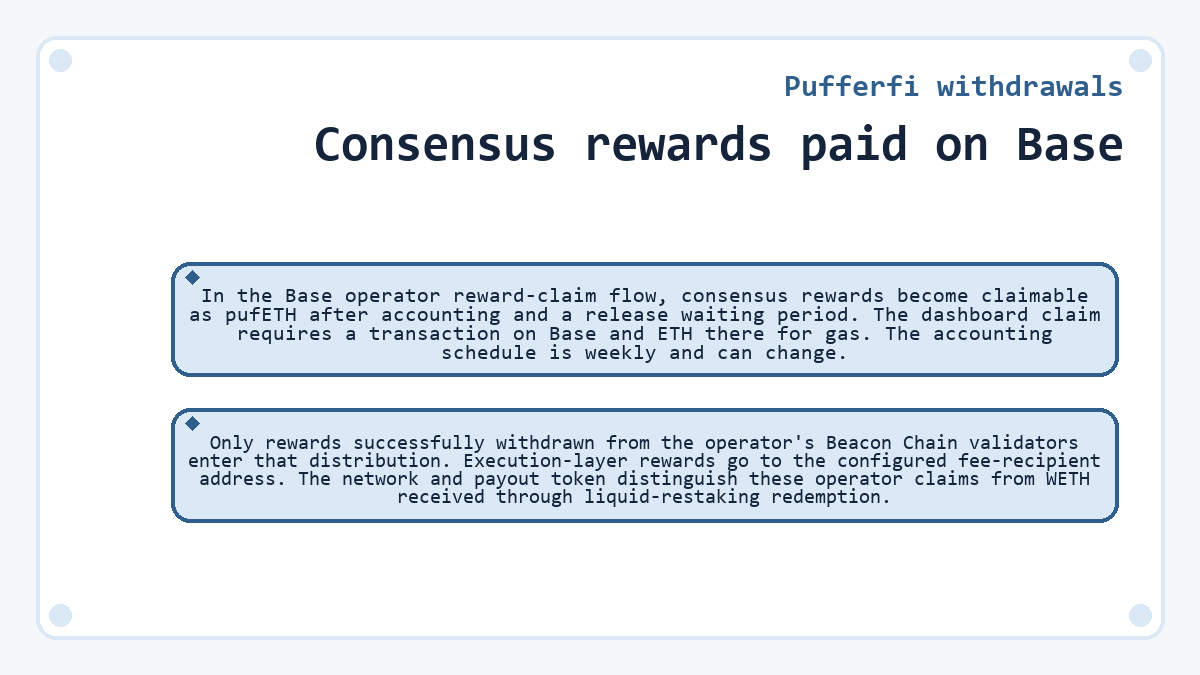
Consensus rewards paid on Base
In the Base operator reward-claim flow, consensus rewards become claimable as pufETH after accounting and a release waiting period. The dashboard claim requires a transaction on Base and ETH there for gas. The accounting schedule is weekly and can change. Only rewards successfully withdrawn from the operator's Beacon Chain validators enter that distribution. Execution-layer rewards go to the configured fee-recipient address. The network and payout token distinguish these operator claims from WETH received through liquid-restaking redemption.
pufETH redemption, institutional exits and UniFi transfers
Puffer's institutional vault has separate ERC4626 share tokens and supports native ETH withdrawals under configurable access permissions. UniFi's L2-to-L1 withdrawal design moves assets between layers, while pufETH redemption converts liquid-restaking tokens into WETH. UniFi uses Trusted Execution Environment (TEE) proofs for its accelerated withdrawal path. That system can fall back to standard dispute resolution if TEE verification fails. Its shorter withdrawal descriptions concern rollup transfers, so they cannot supply a duration or fee for a standard pufETH request.
The existing UniFi Vault carries a separate notice asking depositors to withdraw while a replacement is prepared. That notice addresses assets in that vault. For a pufETH redemption, the next choice remains a liquidity-backed exit with the immediate fee or a standard request followed by a later WETH claim.
Key questions about Pufferfi withdrawals
Do I pay gas for the Permit used in a two-step withdrawal?
The pufETH Permit is a signature and does not incur a blockchain gas fee. Submitting the withdrawal request and completing the later claim require on-chain transactions, which incur network gas.
Will a withdrawal return the same asset I originally deposited?
The documented pufETH withdrawal modes pay WETH, regardless of which supported asset minted the pufETH. Staking supports ETH, WETH, stETH and wstETH, with asset-specific conversion rates. Redemption uses the pufETH being withdrawn and pays the specified output token; it does not reverse the original deposit into its former asset.
Can operators recover unconsumed Validator Tickets after exiting?
Operators can retrieve unconsumed Validator Tickets after exit accounting, subject to applicable penalties. The protocol burns tickets that correspond to time spent validating and returns eligible unused tickets. A voluntary exit before the minimum operating commitment can incur ticket penalties, so an unused ticket balance does not establish an unconditional refund of the original ticket purchase.
Why can a multisig operator have trouble claiming rewards on Base?
An operator that registered validators through a smart contract must configure a rewards claimer address on Base. An Ethereum Mainnet contract address cannot be assumed to identify an accessible account on Base. The operator must designate a Base address that they control. For an externally owned account, the registered operator address is the default rewards claimer on Base; receiving the rewards still requires a claim transaction.
Which validator withdrawals count toward an operator reward claim?
An operator's Base claim covers consensus rewards successfully withdrawn from their Beacon Chain validators within the posted accounting interval. The Current Rewards Epoch identifies the calculation cutoff. Reconciliation includes withdrawals since the last Puffer reward claim and before that epoch, converted using the pufETH exchange rate for that accounting epoch.
Where do the one-step withdrawal fees go?
The withdrawal guide assigns its stated 1% one-step fee to the treasury for protocol improvements and PUFFER token buybacks. PufferVaultV5 has separate settings for fees retained in the vault and fees sent to the treasury, so the live allocation depends on those settings. Ethereum gas fees are separate.