 Pufferfi
 pairs liquid restaking with Ethereum based rollups
Pufferfi combines pufETH liquid restaking with UniFi, an Ethereum based rollup, and Puffer Preconf, a service for early transaction commitments. Staking ETH mints pufETH, which represents ETH backing and reflects rewards through its redemption value. UniFi handles rollup transactions, while Preconf provides early confirmations before Ethereum settlement. The Puffer Finance product family also includes permissionless validator operation and institutional staking access. Puffer's decentralized autonomous organization (DAO) has voting and a governance forum.
Bottom line: Holding pufETH provides staking exposure, while operating a Puffer validator adds bond, ticket and infrastructure obligations.
How does pufETH accrue rewards without changing its balance?
pufETH records rewards in its ETH conversion rate, allowing an unchanged token balance to represent a larger ETH claim. The token is non-rebasing, so reward accrual does not automatically increase a holder's token count. A larger ETH claim still depends on rewards exceeding losses.
ETH backing and native restaking
ETH deposited into liquid restaking funds validators that participate in Ethereum consensus. EigenLayer integration lets validator ETH also secure additional services through native restaking. Holding pufETH combines exposure to those reward streams in a liquid token. The added services bring their own duties and penalty conditions alongside Ethereum validation.
Reward accounting and redemption
Reward payments increase protocol backing relative to pufETH supply. A deposit also increases backing, but the protocol mints corresponding tokens using its conversion rate. That distinction separates new capital entering the pool from income accruing to existing holdings. A deposit amount and the number of pufETH minted therefore need not match numerically.
Redemption value describes the ETH claim represented by the token. The documented pufETH withdrawal routes pay WETH. A one-step liquidity-vault withdrawal charges a 1% fee. The two-step route has no protocol withdrawal fee and a 0.01 pufETH minimum; it requires a completion transaction after batch processing. It can take around 14 days when validator exits are needed, or less if vault liquidity is sufficient. Token accounting alone supplies no fixed withdrawal time, and UniFi's rollup withdrawal design applies to a different product.
Validator Tickets and operator economics
Validator Tickets let operators pay upfront for time operating validators funded by the staking pool. Each ticket represents a validator-day of expected proof-of-stake (PoS) rewards. ETH paid when tickets are minted increases the backing of pufETH. Ticket income therefore reaches holders without waiting for an operator to earn that period's validator rewards.
Operators lock tickets alongside their bond, and ticket consumption determines their allotted operating period. The permissionless registration requirements specify at least 28 tickets. Under this model, operators retain their validator's PoS and maximal extractable value (MEV) rewards. Their income must cover ticket expenditure and operating costs. Poor performance can lower earnings while leaving already-paid ticket costs unchanged. A ticket is priced using expected validator earnings. Its purchase does not establish a fixed return for pufETH holders or the node operator.
Operator collateral and Guardian oversight
Operator collateral provides a first buffer against validator losses, while Guardians supervise registrations, low balances and bond returns.
Collateral and provisioned stake
The permissionless validator configuration specifies a 2 ETH bond, held as pufETH collateral. Puffer provisions 32 ETH for the validator in that configuration, separating the operator's collateral from the stake that the validator operates. Ticket purchases add another capital requirement, so the 2 ETH figure does not describe the total cost of starting or running a node.
Registration checks and validator exits
Guardians review registrations before provisioning validator stake, eject validators when balances become too low and handle bond returns after clean exits. Permissionless entry describes who can register; it does not remove these validation checks.
A bond places operator capital ahead of pufETH holder capital when applicable validator losses occur. Operators recover the full bond when an unslashed validator exits with at least 32 ETH. If an unslashed validator exits below 32 ETH, the shortfall is deducted from the bond. The operator forfeits the entire bond if the validator is slashed. Collateral remains finite, so losses that exceed the applicable protection can reduce token backing; restaking penalties introduce another source of loss. Guardian oversight does not eliminate those economic risks.
UniFi's connection to Ethereum sequencing
UniFi is Puffer's based rollup on Ethereum, with sequencing tied to validators on Ethereum's base layer (L1). As a Layer 2 (L2), it executes transactions in its own rollup environment. Sequencing determines transaction order, while execution applies transactions to the rollup's state. Gateways perform specialized sequencing work on behalf of Ethereum proposers.
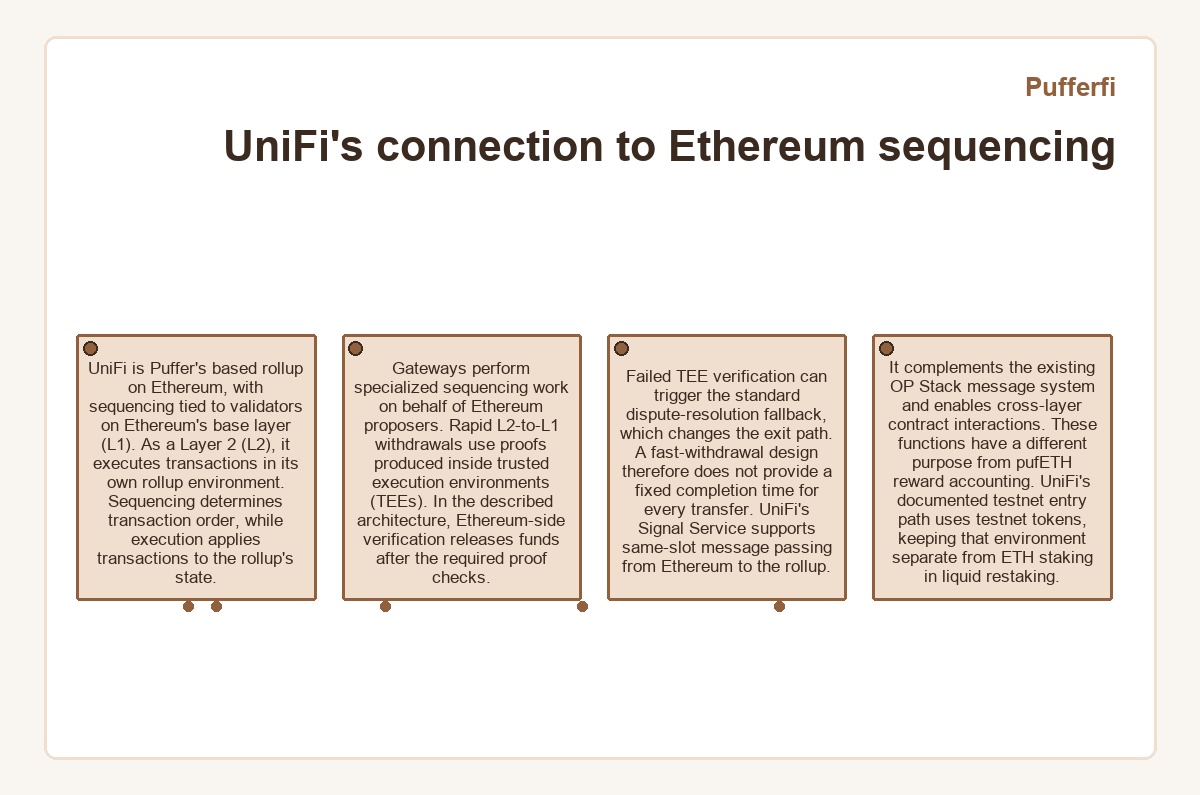
Rapid L2-to-L1 withdrawals use proofs produced inside trusted execution environments (TEEs). In the described architecture, Ethereum-side verification releases funds after the required proof checks. Failed TEE verification can trigger the standard dispute-resolution fallback, which changes the exit path. A fast-withdrawal design therefore does not provide a fixed completion time for every transfer.
UniFi's Signal Service supports same-slot message passing from Ethereum to the rollup. It complements the existing OP Stack message system and enables cross-layer contract interactions. These functions have a different purpose from pufETH reward accounting. UniFi's documented testnet entry path uses testnet tokens, keeping that environment separate from ETH staking in liquid restaking.
Preconfirmations before Ethereum finality
Puffer Preconf supplies early execution commitments through gateways acting on behalf of Ethereum validators. The EigenLayer-based service supports UniFi and, in the documented Phase 1 model, other OP Stack rollups through the Gattaca gateway. An execution commitment concerns a promised state transition, giving a different assurance from a promise to include a transaction in a block. UniFi can return a transaction receipt before its block seals, during a window when preconfirmed state can revert if the unsealed block is discarded. That receipt describes an earlier state than Ethereum finality, so confirmation speed and settlement assurance require separate interpretation.
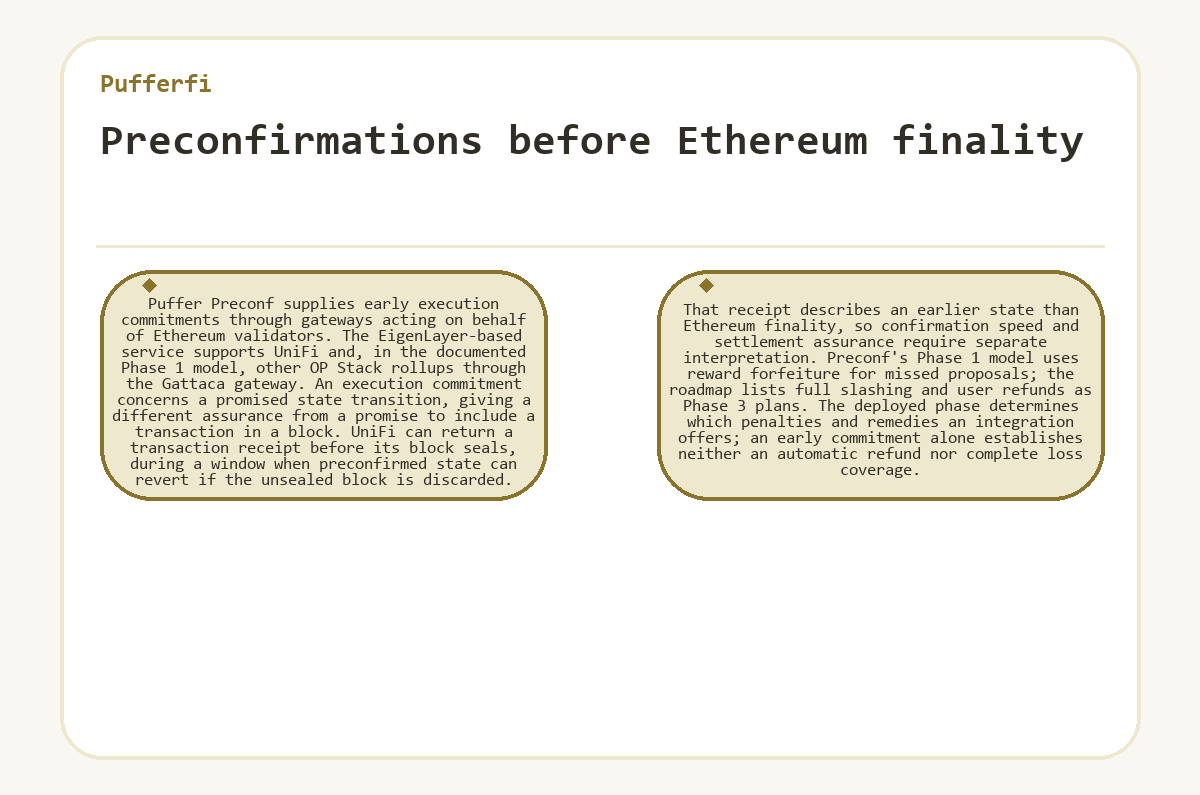
Preconf's Phase 1 model uses reward forfeiture for missed proposals; the roadmap lists full slashing and user refunds as Phase 3 plans. The deployed phase determines which penalties and remedies an integration offers; an early commitment alone establishes neither an automatic refund nor complete loss coverage.
Institutional access and custody arrangements
Puffer Institutional covers configurable staking infrastructure, while the Anchorage Digital partnership gives clients access to pufETH within a custody platform.
Custodied pufETH access
Anchorage Digital clients can mint or acquire pufETH within the Anchorage platform. Custody, compliance workflows and internal controls remain in that environment, with Puffer providing underlying staking and restaking infrastructure. The arrangement brings exposure to Ethereum staking and EigenCloud restaking into the custodied asset. It changes the access and custody workflow; the token still carries the underlying protocol's economic exposure.
Configurable staking infrastructure
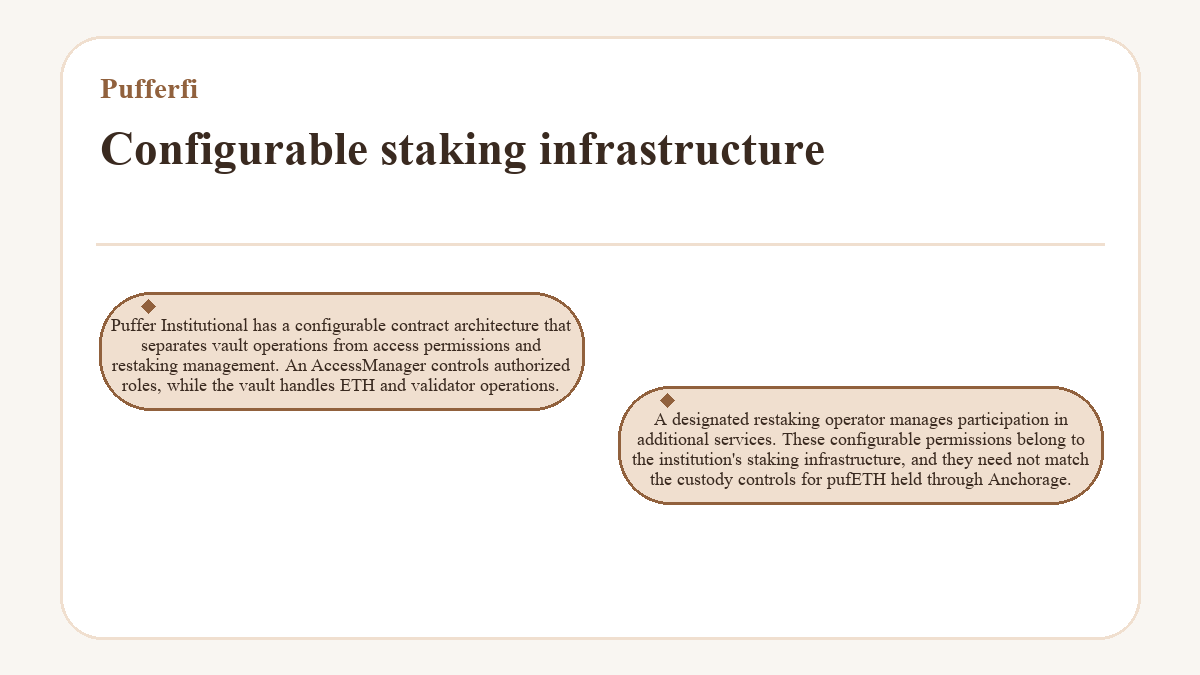
Puffer Institutional has a configurable contract architecture that separates vault operations from access permissions and restaking management. An AccessManager controls authorized roles, while the vault handles ETH and validator operations. A designated restaking operator manages participation in additional services. These configurable permissions belong to the institution's staking infrastructure, and they need not match the custody controls for pufETH held through Anchorage.
What should existing UniFi Vault depositors do?
Puffer asks existing UniFi Vault depositors to withdraw their assets while it prepares a new vault. The notice applies to assets in that existing vault and does not set a launch date for the replacement. Its scope is the vault change, so it should not be read as a timetable for pufETH redemption or the entire UniFi rollup.
pufETH holdings, validator operation and UniFi transactions
An unchanged pufETH balance can still reflect reward accrual because income affects ETH backing per token. A fast UniFi receipt can still describe an unsealed block. Validator participation adds bond and ticket requirements; custody and withdrawal conditions depend on the product held.
- Use the pufETH conversion rate when the task concerns accrued staking income.
- Include tickets and node operation alongside collateral when assessing validator participation.
- Distinguish gateway preconfirmation, block sealing and Ethereum finality when the task concerns transaction settlement.
- Identify the holding product before applying liquid-restaking, rollup or existing-vault withdrawal conditions.
- Separate Anchorage custody controls from the protocol risks that remain within a pufETH holding.
For an exit that must return ETH to Ethereum, identify the relevant product's withdrawal path before relying on its speed claims.
Helpful answers about Pufferfi
What token standard does pufETH use?
pufETH uses the ERC-20 token standard on Ethereum. That standard defines balance tracking, transfers and allowances for contracts spending tokens. Its non-rebasing accounting remains a separate property: rewards affect the ETH conversion rate. Support in a particular application depends on that application's integration; ERC-20 compatibility alone does not establish pufETH as an accepted collateral asset.
How do staking permissions differ between ETH and token deposits?
Native ETH needs no token-spending permission, while Puffer's documented token deposit routes use a Permit or approval. For stETH and wstETH, the flow uses a Permit signature. The documented WETH route uses an on-chain approval transaction. A Permit signature itself incurs no network gas charge. The staking transaction is separate from that authorization and still requires gas.
Does Puffer Preconf require a Puffer governance token?
Puffer Preconf does not require a Puffer governance token for participation as a validator, gateway or rollup. Infrastructure and integration requirements still apply. This rule concerns Preconf participation; it does not remove the separate bond and Validator Ticket requirements for a node operator in the liquid-restaking protocol.
Can Puffer node operators choose their MEV strategy?
Puffer node operators can choose their validator's maximal extractable value (MEV) strategy. The liquid-restaking design lets operators retain their validator's execution rewards, which makes that choice relevant to operator economics. Ticket costs and validator performance still affect profitability. MEV autonomy concerns validator operation; it does not give a pufETH holder direct control over transaction sequencing.
Is UniFi fully equivalent to the Ethereum Virtual Machine?
UniFi is mostly equivalent to the Ethereum Virtual Machine (EVM), with documented opcode differences. Familiar Ethereum development tools can therefore support contract work, although contract behavior depends on the opcode support that UniFi implements. EVM compatibility does not make the rollup's preconfirmation or withdrawal semantics identical to Ethereum's.
Why does a UniFi receipt show a zero block hash?
A zero blockHash with a populated blockNumber marks a preconfirmed UniFi transaction whose block has not sealed. This is an expected RPC state. The zero hash is unsuitable for fetching a block. Receipt logs may already appear, while log queries and subscriptions only cover sealed blocks. Once the block seals, the transaction reports its real block hash.